2026 ranking
Best hospitals for Microfracture Surgery in 🇮🇳 India
Hospitali 8 kutoka hifadhidata ya Medcasts, zimepangwa kwa hadhi ya kituo cha ubora, ukadiriaji wa wagonjwa na idadi ya maoni. Itumie kama orodha fupi ya kuanzia, si uamuzi wa mwisho.
Methodology: how we rank · pricing
- Hospitali zilizopimwa
- 8Hospitali zilizopimwa
- Wastani wa ukadiriaji
- 4.5Wastani wa ukadiriaji
-
 01 Dhahabu Medanta - The Medicity
Why #1: Center of Excellence in microfracture surgery · 4.7 rating across 412 reviews
Medanta is a multi-super specialty hospital founded by Dr. Naresh Trehan. Known for comprehensive care across 20+ specialties with 1600 beds, advanced research facilities, and world-class cardiac care.
★ 4.7 · 412 reviews 1,600 beds Est. 2009From$3,660all-in · case-specific -
 02 Fedha Max Super Speciality Hospital, Saket
Why #2: Designated Center of Excellence with dedicated program volume in microfracture surgery
Max Saket is part of the Max Healthcare network. A leading 500-bed hospital known for cardiac sciences, orthopaedics, and oncology with JCI accreditation. Founded in 2006, the hospital sits in New Delhi, India. Clinical …
★ 4.3 · 320 reviews 500 beds Est. 2006From$3,430all-in · case-specific -
 03 Shaba Indraprastha Apollo Hospital
Why #3: Top patient-rated in this country (4.9/5 across 520 reviews)
Indraprastha Apollo is the flagship hospital of the Apollo Group in New Delhi. A 700-bed facility offering a wide range of specialties with JCI accreditation and India's first proton therapy center. Founded in 1996, the …
★ 4.9 · 520 reviews 700 beds Est. 1996From$3,320all-in · case-specific -
 04 Artemis Hospital
Why #4: Large multi-specialty centre (600+ beds) — broad consultative depth
Artemis Hospital is a JCI and NABH accredited hospital in Gurgaon, India. The hospital was founded in 2007 by the promoters of the Apollo Group, as a multi specialty hospital providing research and technology oriented …
★ 4.5 · 285 reviews 600 beds Est. 2007From$3,550all-in · case-specific -
 05 Amrita Hospital Faridabad
Why #5: Large multi-specialty centre (2,600+ beds) — broad consultative depth
Amrita Hospital is a private tertiary care hospital in Faridabad, NCR Delhi, India. It is the largest private multi-specialist and superspeciality hospital in Asia, and was inaugurated by Prime Minister Narendra Modi. It…
★ 4.4 · 180 reviews 2,600 beds Est. 2022From$3,310all-in · case-specific -
 06 Sarvodaya Hospital
Why #6: Verified accreditation, transparent pricing, dedicated international patient desk
Sarvodaya Hospital is a multi-specialty healthcare facility in Faridabad offering comprehensive medical services with modern infrastructure and experienced medical professionals. Founded in 2008, the hospital sits in Far…
★ 4.1 · 150 reviews 500 beds Est. 2008From$3,430all-in · case-specific -
 07 National Institute of Mental Health and Neurosciences
Why #7: Established 1974 — long institutional track record
The National Institute of Mental Health and Neuro-Sciences (NIMHANS) is a medical institution in Bengaluru, India. NIMHANS serves as the apex centre for mental health education and neuroscience research in the country. I…
Est. 1974From$3,770all-in · case-specific -
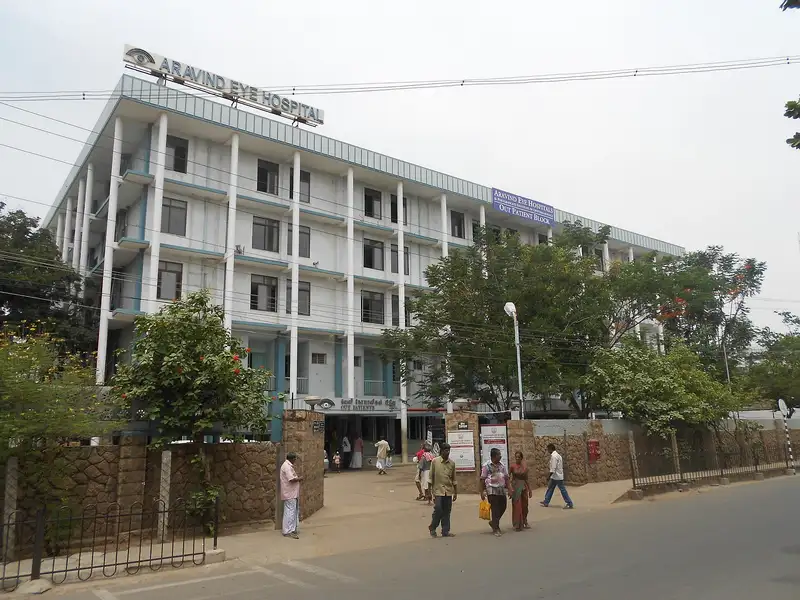 08 Aravind Eye Hospital
Why #8: Established 1976 — long institutional track record
Aravind Eye Hospitals is a hospital chain in India. It was founded by Dr. Govindappa Venkataswamy at Madurai, Tamil Nadu in 1976. It has grown into a network of eye hospitals and has had a major impact in eradicating cat…
Est. 1976From$3,410all-in · case-specific
Jinsi orodha hii inavyopangwa
Kinachoamua mpangilio
Hospitali hupangwa kwa sehemu hizi za hifadhidata yetu, kwa mfuatano huu. Hakuna kingine kinachopimwa.
Hatupimi matokeo ya matibabu, idadi ya upasuaji wa daktari wala machapisho. Uliza kila hospitali idadi ya kesi za kila daktari kabla ya kuamua.
- 1Hadhi ya kituo cha ubora
Hospitali zilizotambuliwa kama kituo cha ubora kwa utaalamu huu huja kwanza.
- 2Ukadiriaji wa wagonjwa
Wastani wa juu wa ukadiriaji hupanda juu zaidi.
- 3Idadi ya maoni
Huamua sare kati ya hospitali zenye ukadiriaji sawa.
- 4Bei ya chini iliyoorodheshwa
Kwa utaratibu mmoja, bei ya kuanzia iliyo chini huamua sare iliyobaki.
What this list isn't
Rating ≠ outcome
A hospital ranking is a qualifying filter, not a prediction of your outcome. Within any listed hospital, your outcome is shaped by your specific surgeon's volume, the program's protocol for your indication, and your own clinical baseline. Always ask for surgeon-level data — case volume per year, conversion rate, infection rate — before committing.
Hatua inayofuata · Microfracture Surgery
Tuko tayari ukiwa tayari.
Njia tatu za kuendelea. Chagua inayokufaa sasa hivi.
Destination · India
Why patients choose India for microfracture surgery (orthopedics)
India runs one of the world's deepest tertiary-care networks for international patients — over 700 NABH-accredited hospitals and 38+ JCI-accredited facilities, concentrated in Delhi-NCR, Chennai, Mumbai, Bangalore, Kochi, and Hyderabad. The training pipeline is anchored by AIIMS, PGIMER Chandigarh, CMC Vellore, and a clutch of corporate flagships (Medanta, Apollo, Fortis, Max, Manipal, Narayana) where lead surgeons routinely log 5,000+ procedures across a 25-30 year career. For microfracture surgery specifically, India draws patients who want hospital tier-1 outcomes at 60-80% below US/UK list pricing — without compromising on implant brands, robotic platforms (da Vinci Xi is now in 80+ centres), or ICU staffing ratios.
- 01
Surgeon volume is the headline advantage — Indian cardiac and oncology centres run procedure volumes Western centres rarely see, which compresses learning curves and improves outcomes for complex cases.
- 02
English-language medical communication is the default; consent forms, imaging reports, and discharge summaries are issued in English by trained physicians, removing the translator step common in non-English destinations.
- 03
Visa-on-arrival or e-medical visa is available for citizens of ~165 countries, with same-week processing and double-entry options that make follow-up trips painless.
- 04
Direct flight connectivity from the GCC, East Africa, Bangladesh, Nepal, Sri Lanka, the UK, Singapore, Bangkok, and most major US gateways means under-12-hour transit for the majority of medical travellers.
Cost note. Indian pricing is driven by lower clinician salaries, real-estate cost-per-bed, and rupee parity — not by skipping protocols or using grey-market implants.
How to use this list
What to look for
- Surgeon's annual case volume on your specific procedure.
- Implant brand and revision-rate data (10-year and 20-year).
- Sub-specialty match (sports medicine surgeon for sports injury, joint reconstruction for replacement).
- Pre-hab program (4-6 weeks of supervised PT before surgery measurably improves outcomes).
- Inpatient PT integration during admission.
- Outpatient PT continuity for first 12 weeks post-op.
- DVT prophylaxis protocol that extends after discharge.
Volume benchmarks
Surgeon volume benchmarks
Travel timing
When to travel to India
Peak window: October, November, December, January, February, March
Avoid: June, July, August, September
Cool, dry season runs October–March, particularly comfortable for recovery in Delhi, Mumbai, and Bangalore. Avoid June–September monsoon — flooding, humidity, and increased respiratory infections complicate recovery. Delhi winter (December–January) has serious air pollution; consider Bangalore or Chennai during this window if pollution-sensitive.
Questions
What to ask each program on this list
- 01
How many of these implants have you placed in the last 12 months?
- 02
What's your revision rate at 5 years on this implant?
- 03
Why are you choosing this implant or approach for me specifically?
- 04
What's the rehab plan, and is physiotherapy included in the package?
- 05
What's your DVT prophylaxis protocol, and do you continue it after I fly home?
Adjacent rankings
Other ways to slice Microfracture Surgery in India
Best-of lists are one cut. These hubs let you re-rank by destination, by city, by surgeon volume, or by procedure.
- Procedure Microfracture Surgery overview All microfracture surgery programs across all destinations.
- Procedure cost Microfracture Surgery cost in India Hospital-reported pricing, stay, recovery for India programs.
- Destination India hospital hub Featured programs and pricing benchmarks for India.
- Surgeons Orthopedics surgeons Volume-ranked physician directory across all destinations.
- Surgeons Orthopedics surgeons in India Filtered to India-based programs only.
- Hospitals All India hospitals Filter by city, specialty, accreditation, beds.
- Hospitals Hospitals filtered by Orthopedics Programs credentialed for orthopedics across all destinations.
- Browse Other best-of rankings All specialty × country ranking combinations.
- Compare Hospital comparison Side-by-side accreditations, ratings, beds, and pricing for up to 4 hospitals.
- Compare Doctor comparison Surgeons compared on volume, fees, languages, video-consult availability.
- Tool Cost calculator Hospital-reported pricing for orthopedics procedures across destinations.
- Tool Match-me triage Three questions, get a specialty + destination + 3-hospital shortlist.
- Trust Editorial policy Methodology behind ranking, AI disclosure, corrections SLA.